I Tested 3 AI Manuscript Editors So You Don’t Have to Waste Your Money
I tested the best AI manuscript editors today and he are the best 3 that will give oyu the best value for your buck.
TLDR: After testing the major AI tools today, editGPT turned out to be the best AI manuscript editor in 2026.
Hiring a human manuscript editor is usually the biggest expense for any writer, often costing thousands of dollars per project. Because of that, many people try to get by with standard grammar apps.
The catch is that most of these tools aren't actually editors. They’re just glorified spellcheckers that focus on surface-level typos while ignoring the deeper flow of your story because they don’t get your context and intention.
I spent a few weeks testing every major AI manuscript editor to find out which ones can truly handle a longform document without lagging. While some platforms just nag you about passive voice, a few have finally started to understand things like structural logic and character consistency.
After running my test chapters through them, editGPT stood out as the only one that feels like a real collaborative partner for long-form work.
Here’s a look at the tools that actually made the cut so you can stop throwing your capital at software that only knows how to find a comma.
Quick Verdict: Best AI Manuscript Editors Ranked
What Is an AI Manuscript Editor?
To understand these editing tools, you have to separate the different layers of the editing process. Most people use these terms interchangeably, but they represent very different tasks for your book.
What Is The Difference Between Proofreading, Editing, and Manuscript Editing?
Proofreading is the final safety net that catches small typos and missing commas before you publish. At this point, both major and minor errors should have been eliminated during the editing process. That makes this one of the most important and crucial steps before you publish your book.
Standard editing goes deeper by looking at your sentence structure and word choice to ensure your ideas are clear.
However, manuscript editing is the big-picture phase where you fix the organization and pacing of an entire book. While a basic app might fix a misspelled word, a true book editing tool needs to understand how a change on page ten impacts a scene on page fifty.
What Writers Should Actually Expect
When you use a tool designed for long-form work, you aren't just looking for a better spellchecker.
You should expect the software to act like a digital professional editor that identifies where your narrative drags or where your tone shifts instead of just working like the regular online proofreader.
These AI models analyze the context of your entire project to suggest rewrites that keep your voice intact while tightening the logic. It won’t replace a human's emotional intuition, but it handles the heavy lifting of restructuring clunky chapters and refining your prose at scale.
How I Tested These AI Manuscript Editors
I didn't just run a few paragraphs through these tools and call it a day. To see if they could actually replace manuscript editing services, I uploaded a complete 80,000-word fiction draft and a dense 40-page non-fiction report.
This helped me see which manuscript editor would crash under the pressure and which ones could actually edit without ruining the style and context the texts have.
The Testing Criteria
To find a legitimate alternative to an expensive book editor, I judged each platform based on several key factors:
- Long-form handling: The software had to process 10,000+ words in a single go without lagging or timing out.
- Context awareness: looked for tools that actually grasp your voice, tone, and intention so the edits don't strip away your personality.
- Structural editing ability: I checked if the AI could analyze the internal logic and flow of the writing to suggest meaningful rewrites that strengthen the overall argument or narrative.
- Readability improvement: The suggestions needed to tighten the prose without stripping away my personal writing voice.
- Ease of use: I prioritized apps that let me edit directly in Word or Google Docs to avoid constant copying and pasting.
- Value vs. hiring an editor: I weighed the results against the high cost of human book editing to see if the subscription actually pays for itself.
editGPT Review (Best Overall AI Manuscript Editor)
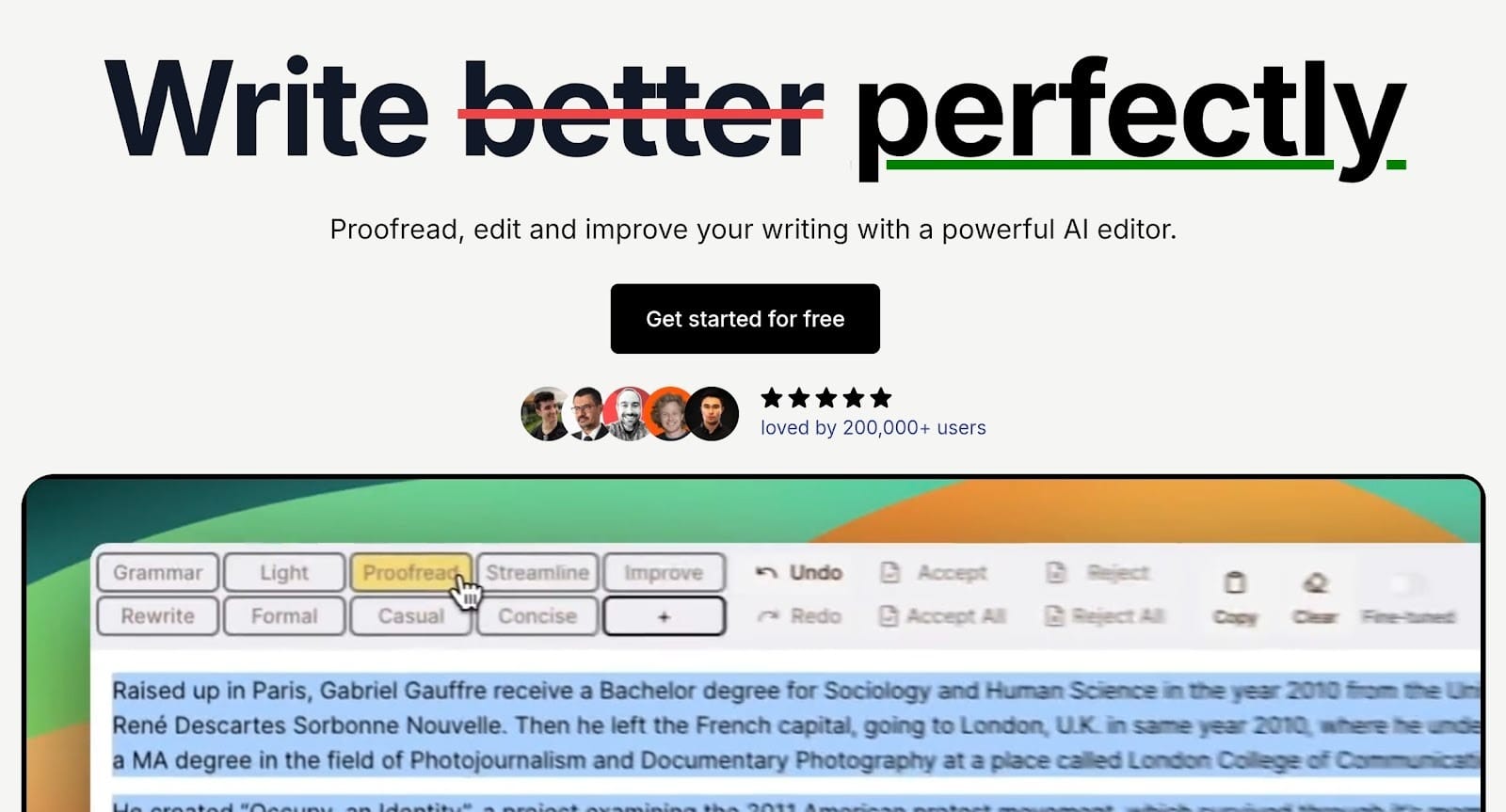
Most tools act like a strict teacher with a red pen, just basically proofreading without context and hunting for misplaced commas while completely missing the point of your story.
editGPT is a rare exception because it focuses on the actual intention of your writing, offering the kind of contextual editing that used to require a human collaborator. I like how it gets your voice and intention and edit as it preserves that for you.
What it does best
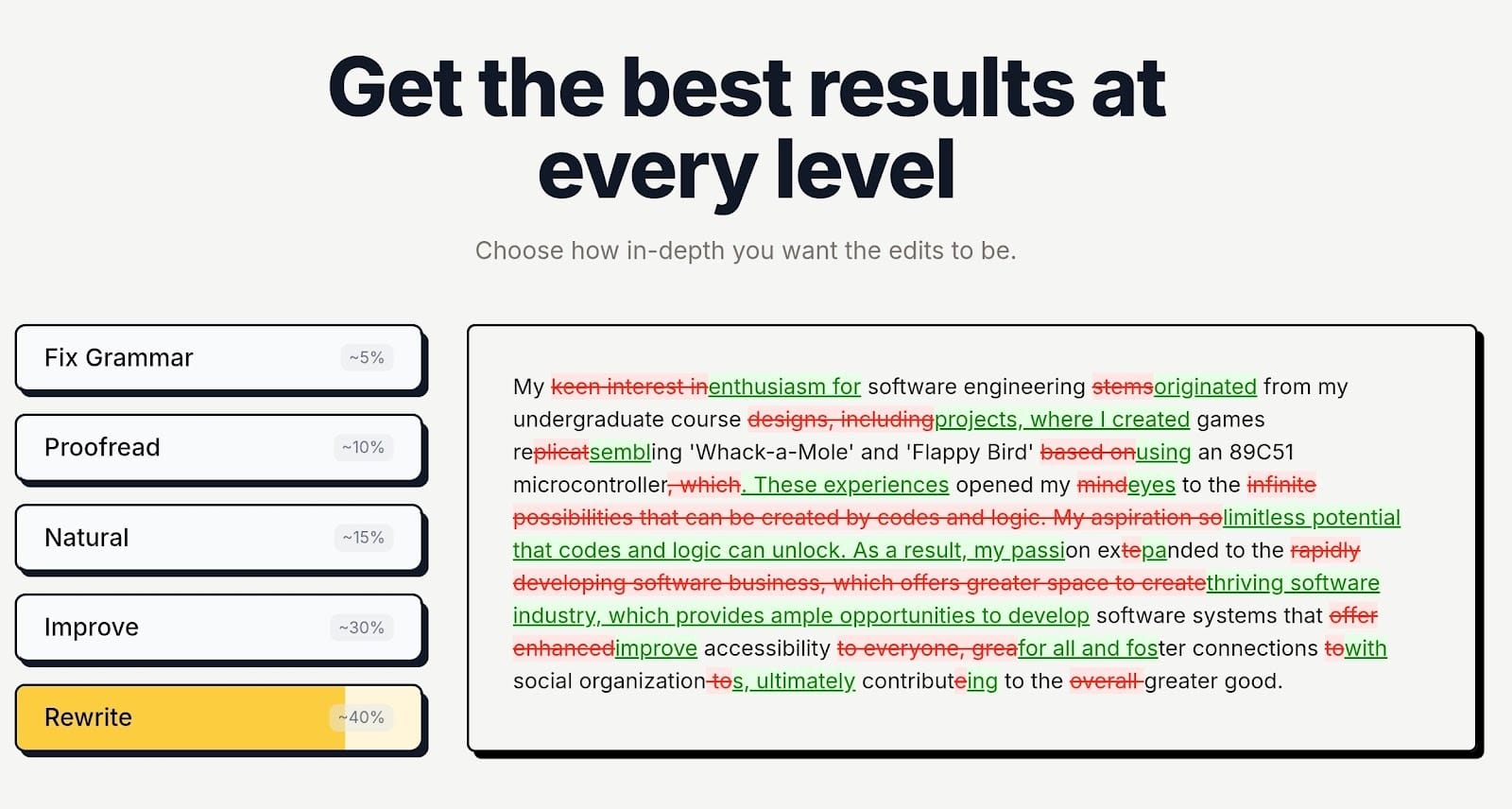
This manuscript proofreading tool stands out for its ability to handle deep, contextual rewrites that respect your authorial voice. Instead of just flagging technical errors, it analyzes the rhythm of your prose to suggest improvements that make your writing sound natural and fluid.
It’s built specifically for long-form projects, so you can edit a full 80,000-word manuscript in "Project Mode" without the software lagging or losing its grasp on your established style.
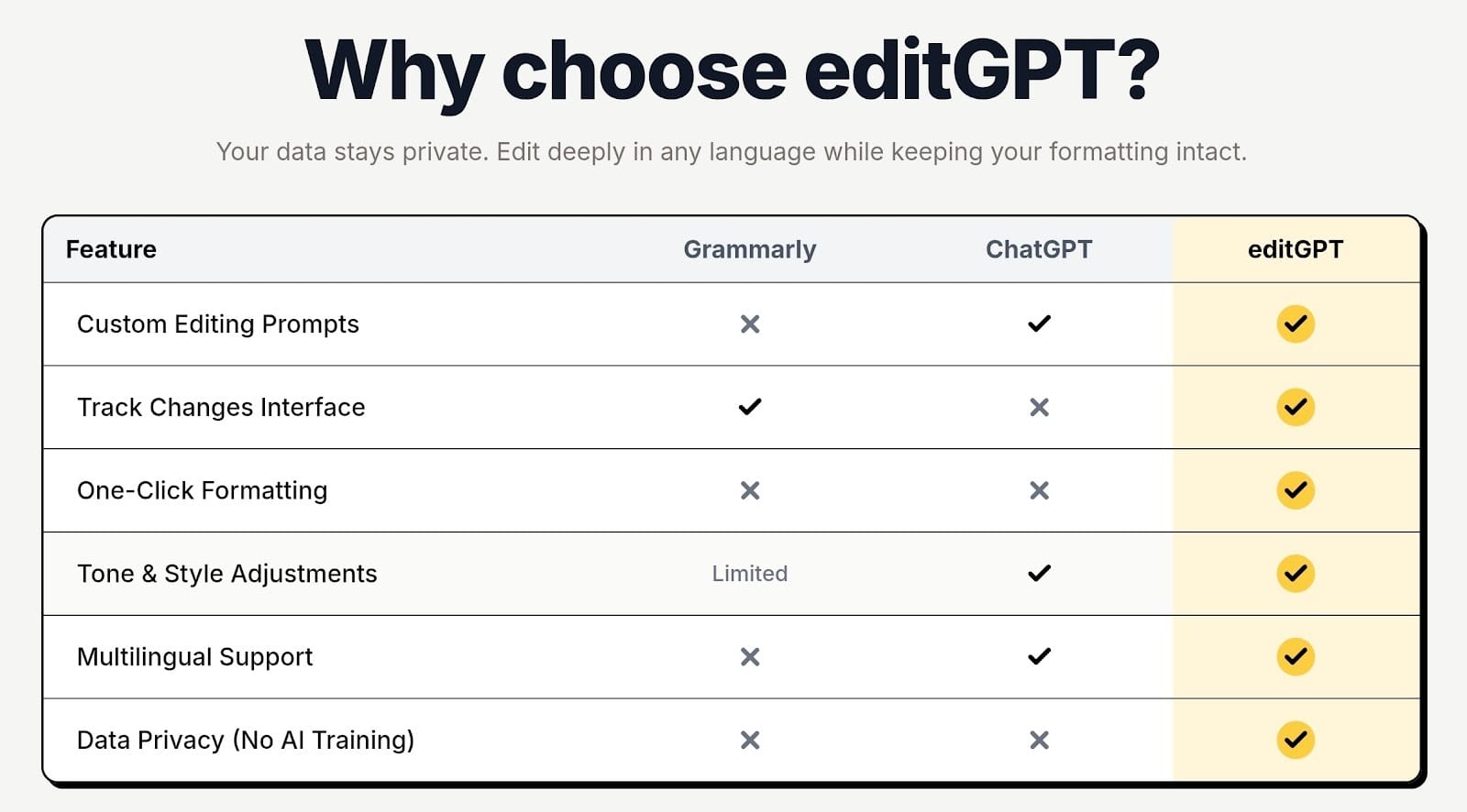
Not to mention, it’s also very user-friendly with a really clean UI and track changes.
Features
- Context-aware editing: editGPT’s AI recognizes the difference between a creative stylistic choice and a genuine mistake, preserving your specific voice.
- Rewriting suggestions: You get direct, flow-based improvements that fix awkward transitions and wordy paragraphs in seconds.
- Full manuscript handling: You can import and export Microsoft Word files directly, keeping your original formatting (as well as the tracked changes) intact across hundreds of pages.
Weakness
The interface is focused purely on the text and lacks the colorful graphs or "readability scores" found in tools like ProWritingAid.
Pricing
Hiring a professional editor is a significant investment today, with copyediting alone starting around $1,600 for a standard novel. If you need developmental work, those fees often climb past $5,000 per project.
In contrast…
When you look at the cost of hiring a pro, editGPT’s monthly rates are a steal for the level of polish you get. The Pro Plan is $10 per month, which gives you a 500,000-word limit and allows for advanced features like batch editing and custom prompts.
For those working on multiple books at once, the Elite Plan is $25 per month, bumping your limit to 2 million words while providing priority processing speeds.
Best for
- Writers self editing
- First draft cleanup
- Reducing editing costs
ProWritingAid Review
Unlike editGPT, which rolls up its sleeves to rewrite your sentences to match a specific intent, ProWritingAid acts as a high-level analyst for your manuscript.
It doesn’t try to do the hard work for you, but it gives you more technical data about your writing habits. This book editor is built for writers who want to dive deep into the metrics of their work rather than just getting a quick, automated polish.
Strengths
- Detailed reports: You get over 25 different writing reports that break down everything from your pacing and dialogue tags to your use of sensory details.
- Style and readability insights: The software identifies technical issues like "sticky sentences" and overused words, giving you a clear path to tightening your own work manually.
Weaknesses
The main drawback is that ProWritingAid acts more like a teacher than a co-writer. It won't actually rewrite or edit deeply with the same contextual "human" touch you see in other tools, so you have to go through every single suggestion one by one.
Best for
- Self-editing with guidance
AutoCrit Review
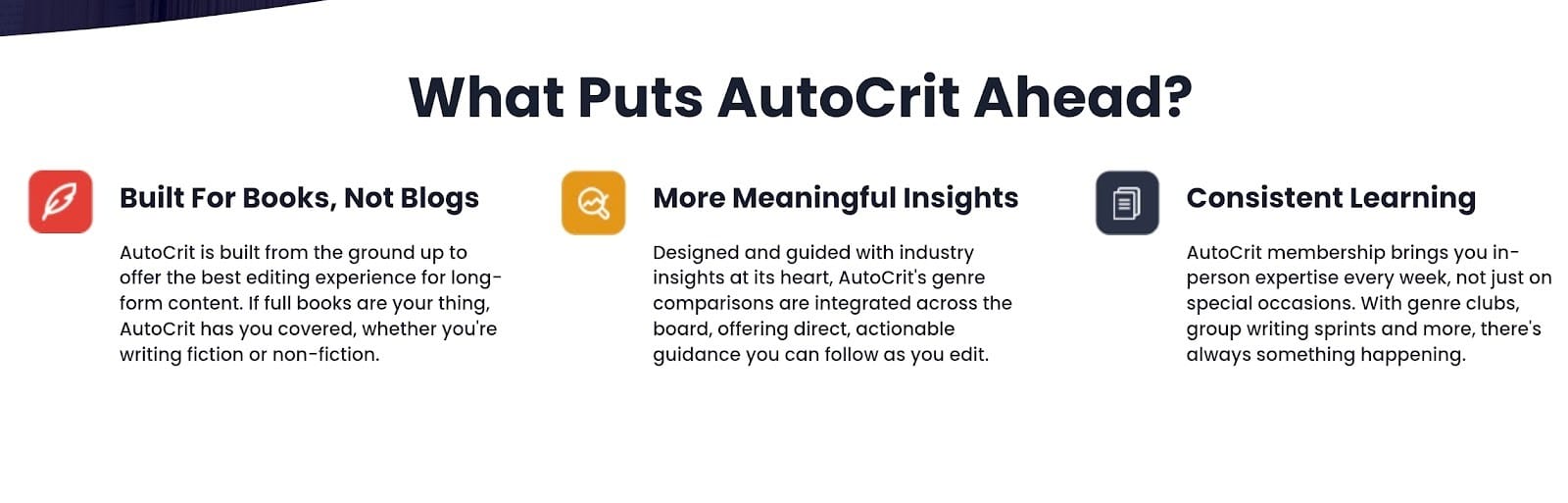
If you’re drafting a novel and feel like your pacing is off or your dialogue sounds a bit wooden, AutoCrit can act as a digital beta reader built specifically for fiction.
Upon testing it, it didn’t try to be a general-purpose tool for business emails or academic papers. Instead, it focused entirely on the mechanics of storytelling.
This manuscript proofreading tool excels at identifying the subtle rhythm of a story that general grammar checkers usually miss. It offers genre-specific benchmarking, which lets you compare your word choices and pacing against successful thrillers, romances, or mysteries to see how you stack up.
Strengths
- Dialogue and pacing analysis: This tool flags clunky dialogue tags and highlights areas where your story drags, helping you keep the reader engaged.
- Repetition detection: You get a detailed breakdown of your overused phrases, which is a lifesaver when you are deep into a second draft.
Weaknesses
The biggest tradeoff is that AutoCrit can be limited if you step outside the world of fiction. It tends to lack the flexibility for technical or professional business writing. You also have to do most of your work within their specific interface, which can feel less fluid than tools that integrate directly into every browser or app you use.
Best for
- Novel editing
AI Manuscript Editor vs Professional Editor
Choosing between a digital tool and a human professional isn't about finding a "winner." It’s about knowing which one fits your current draft. One offers instant speed, while the other provides the kind of intuitive feedback that a machine simply can't handle yet.
AI Manuscript Editor
In 2026, editing a book with AI editors is incredibly fast (even the free book editor ones). You can scan a 100,000-word manuscript for technical errors in just a few minutes. These tools are also very affordable. Most pro-level subscriptions cost between $10 and $30 per month.
This makes them perfect for a first pass.
You can use them to clean up the easy stuff, like grammar, repetitive words, and basic pacing, before anyone else sees the work. It’s a smart way to get your draft into respectable shape while saving your main budget for the final stages.
Great ones can even do more than spellchecking and proofreading. They can suggest better fixes for your text’s structure, as well as better words that fit the tone you set.
Human Editor
A human editor brings structural insight that an algorithm usually lacks. They can tell you if a character’s motivation feels forced or if your plot has a hole that ruins the ending.
However…
…this expertise is a significant investment. A full developmental edit for a novel today typically starts around $0.07 per word, which means an 80,000-word book can cost over $5,600. You aren't just paying for spellcheck. You’re paying for a creative partner who understands the emotional heart of your story.
So, what’s the best choice?
The best approach for most authors is a hybrid one. You can use an AI tool to handle the initial technical cleanup and surface-level polishing. For tools with contextual editing, you can also use them for the final checking of your manuscript.
This ensures you submit a much cleaner draft to a pro. By removing the "easy" errors first, you often reduce the total hours a human editor needs to bill you.
It makes sure your money goes toward their most valuable creative skills rather than just fixing typos.
Can AI Replace a Human Book Editor?

AI won't take over the manuscript editor's chair completely, but it can certainly handle the heavy lifting to help you lighten the load.
Today, these AI manuscript editing tools have evolved into high-powered first-stage editors that manage the tedious technical cleanup. They flag repetitive phrases and grammar hiccups in seconds so you don't waste a human professional's time on the basics. The very well-made tools can even do more.
This lets your editor focus entirely on the story's emotional heart and structural integrity.
How to Choose the Right Manuscript Editor
Getting an editor involves deciding between the speed of automated software and the nuance of a professional human. Use this writers checklist to learn how to find an editor for your book who actually aligns with your creative vision and budget.
- Type of Writing: Confirm the specialist or tool understands your genre, as fiction editors focus on narrative arcs while non-fiction experts deal with fact-checking and logical flow.
- Editing Depth Needed: Decide if you need a deep developmental edit to fix structural holes or a simple copyedit for grammar. AI tools are great for catching repetitive words and typos, but you’ll want a human for high-level tasks like character motivation or plot consistency.
- Budget: Professional human rates often cost over thousands of dollars for a full novel, while AI subscriptions typically range from $10 to $30 per month. Many writers now use a hybrid approach by cleaning the draft with AI first to reduce the total hours a human editor needs to bill.
- Workflow: Confirm how many revision rounds are included in a human editor's quote or the package you got with your AI editing tool.
Final Verdict
I spent several weeks testing these platforms with different manuscript types to see how they actually handle real-world writing. Each tool excels in a specific area, so your choice depends on what part of the process you find most difficult. These are the winners based on those hands-on tests.
Best overall → editGPT
Best for analysis → ProWritingAid
Best for fiction → AutoCrit
Choosing the right tool depends entirely on your current goals and how much work you have left on your draft. You might find that a combination of these yields the cleanest results before you finally hand your book over to a human professional.
editGPT came out as the best overall as it fits with most writing needs and styles and is one of the few with intelligent contextual editing.
Check their pricing tiers now to see what fits yours.
FAQ
What is a manuscript editor?
This is a person ( or can also be a tool) you get to find and fix problems in your book, like plot holes that don't make sense or weirdly slow pacing. They basically work on the clarity of your writing so your readers actually stay interested and don't get confused by the prose.
Is AI manuscript editing worth it?
It's definitely worth it for that initial cleanup because it catches technical errors way faster and cheaper than any human can.
Can AI edit a full book?
AI can scan a whole novel in seconds to find repetitive words or basic punctuation fails, but it still misses deep emotional logic. It works best as a first-pass tool, though software like editGPT is getting much better at handling longer drafts with a more human-like flow.
How much does manuscript editing cost?
Today, a human editor might charge you anywhere from $1,000 to over $5,500 depending on the specific word count and work needed. AI tools are much cheaper, usually costing under $30 a month, which is why most writers use them to polish their drafts before hiring a person.
How to find an editor for your book?
The best way to find someone is to check the acknowledgments in books you actually like or use a vetted site like Reedsy. You should always ask for a short sample edit before paying anything to make sure their feedback style really works for your specific story.
Difference between proofreading and editing?
Editing is the heavy work where you move sections around and fix the tone, while proofreading is just the final check for typos. You can use editGPT to help with that mid-stage editing, but you still need a separate proofread right before you hit publish.
Recommended Reading
What is the best AI Proofreader?
Top 10 Creative Writing Tools in 20206
Best AI Proofreader Tools of 2026 (Tested for Accuracy, Speed & Tone)
Best AI Proofreader Chosen by the Reddit Community
Video review: This AI Text Editing Tool Is FLAWLESS!
Best AI Proofreader Tools of 2026 (Tested for Accuracy, Speed & Tone) editGPT vs Grammarly vs Quillbot: Which Writing Tool is Best?
The Best AI Proofreaders That Actually Work (Free & Paid)
Review: Wordtune Editor vs editGPT
Review: Grammarly vs editGPT
Review: ProWritingAid vs editGPT
Review: Hemingway Editor vs editGPT